
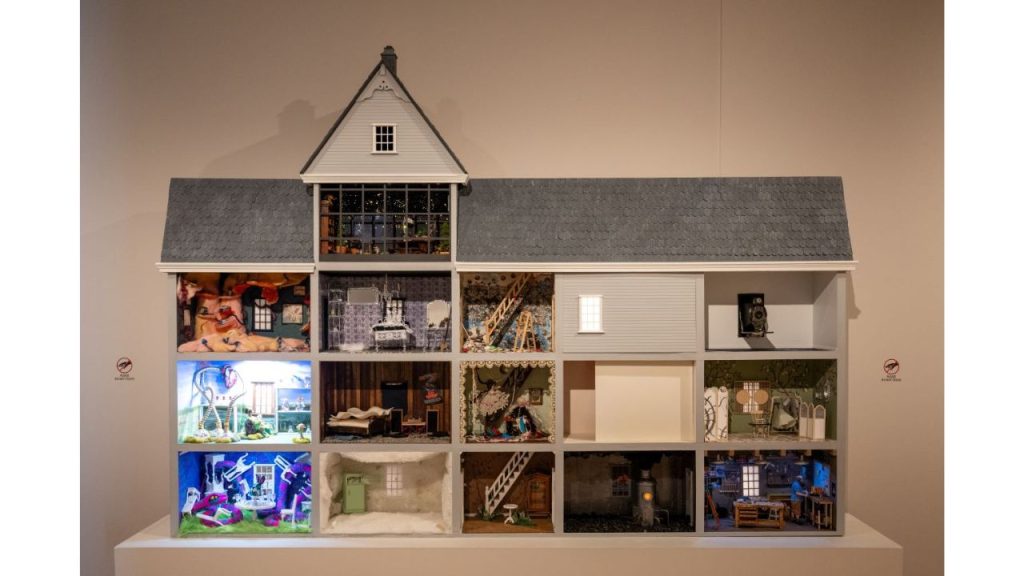
Sixteen faculty members from the ODU Department of Art collaborated on the installation as part of the “Dollhaus: Reimagining the Domestic Space” exhibition which opened Aug. 27 at the Barry Art Museum.
NORFOLK, Va. – (Sept. 9, 2024) – Just as the Bauhaus art movement married various artistic styles together under one roof, the Barry Art Museum’s latest exhibition, “Dollhaus: Reimagining the Domestic Space,” will showcase the diverse contributions of Old Dominion University’s Department of Art with a full-size dollhouse installation.
Sixteen artists created different rooms for the dollhouse – from bedrooms to formal dining rooms to nurseries – applying techniques in glass, textiles and painting.
This collaborative artwork also responds to museum co-founder Carolyn Barry’s dollhouse – an exquisite recreation of the interior of their home featuring miniature versions of the Barry’s and their artworks – which will be featured alongside the new dollhouse in the exhibition.
“Dollhaus” opened Aug. 27 and will be on view through Jan. 5, 2025.
“A major goal of this exhibition is to celebrate the creativity of ODU’s faculty,” said Sara Woodbury, curator of art. “It’s been deeply satisfying to get acquainted with each participant’s studio practice and to see all their diverse interests and working methods come together in one project.”
Peter Eudenbach, a professor of art, created the sunroom using two forms of photography – an old camera which extends into the room and a cyanotype print made using chemically treated paper exposed to the sun. If you look into the camera’s lens, you can see an image of another artwork he created that is part of the Barry Art Museum’s permanent collection.
“My work has always been concerned with the relationships between sculpture and photography,” Eudenbach said.
Julia Rogers, who teaches glass at ODU and serves as the Higher Education and Outreach Coordinator at the Chrysler Museum Glass Studio, chose to create a “regenerative nursery” using flame-worked glass, blown glass and mixed media.
In her futuristic work, there is a symbiotic relationship between plants and humans with incubators and egg pods.
“Incorporating social concepts is important in my personal work and I push students to think creatively about ideas and what message they want to convey to their audience,” Rogers said.
John Roth, an associate professor of sculpture and chair of the Art Department, chose to create the utility room which features a hulking machine spewing black smoke.
“This choice allows me to reference my research interests in resource consumption and climate change,” Roth said. “The concept hopefully will trigger thought about modern convenience and comfort and its actual cost.”
Vittorio Colaizzi, an associate professor of art history, chose to create a bedroom that explores concepts of privacy and interiority.
“Instead of filling the space with objects, I obstructed the view of an empty room with an inset wall painted flat white,” Colaizzi said. “The back wall, painted glossy white, reflects a rosy aura of brightly colored walls hidden from view.”
Mimi King, an adjunct instructor who teaches printmaking, 2D design and color theory, created the library which visually represents how books come to life in our heads.
“As a printmaker, my work exists primarily in the 2D, and translating those skills into the third dimension was a very fun challenge for me,” King said.
Jamie Robertson, assistant professor of art and director of the photography program, drew on childhood memories of her grandmother defrosting her avocado green refrigerator when creating the dollhouse’s kitchen, titled “Defrost.”
“I am a lens-based artist, so constructing something three-dimensional was challenging but fun,” Robertson said.
In addition to the dollhouses, the exhibition will include several 19th-century artworks. One is a novelty porcelain doll created by French artist Jacob Petit (1796-1868) whose skirt opens to reveal a kitchen.
Professor Eudenbach said the ideas of revelation included in the exhibition speak to the larger purpose of a museum.
“Any museum is already a dollhouse of sorts since it is a series of rooms for display,” he said. “They are real spaces but always set apart from the world outside. With this project, each artist has created a room to be part of a house which is itself an object in a room in the museum. In this sense the exhibit resembles a Russian doll.”
###
IMAGE CAPTION: Photo of dollhouse created by ODU Department of Art faculty members. Photo by Chuck Thomas/ODU
ABOUT THE BARRY ART MUSEUM
The Barry Art Museum is positioned at the gateway to Old Dominion University, at 1075 W. 43rd Street in Norfolk, Virginia. Opened in 2018, the museum features a glass sculpture collection from internationally recognized artists, which contributes substantially to the region’s growing reputation as a glass art center. The museum’s collection also includes American modernist paintings, historic and antique dolls, and automata. The museum is committed to expanding its collection to support a diverse body of work from contemporary and living artists. The Barry Art Museum is open Tuesday through Friday 11 a.m.– 5 p.m., Saturday and Sunday 12–5 p.m. Admission is free, along with a full programming calendar, and multiple rotating exhibitions annually.
ABOUT OLD DOMINION UNIVERSITY
Old Dominion University (ODU), located in Norfolk, is Virginia’s forward-focused public doctoral research university with more than 24,000 students. A top R1 research institution offering rigorous academics, ODU is recognized nationally for academic excellence, social mobility and access. Military friendly and home to an energetic residential community and robust initiatives that currently contribute $3.8 billion annually to Virginia’s economy, ODU is a leader in the commonwealth. Macon & Joan Brock Virginia Health Sciences at Old Dominion University, founded July 1, 2024, represents the most comprehensive health sciences center in the Commonwealth of Virginia.